
china solar energy
2026-01-10
China Solar Energy: Leading the Global Renewable Revolution
In the global pursuit of carbon neutrality and sustainable energy transition, China has emerged as an undisputed leader in the solar energy sector. Over the past decade, China's solar industry has evolved from a follower to a global pacesetter, driving innovations in technology, expanding large-scale applications, and reshaping the global energy landscape. This blog delves into the remarkable growth of China solar energy, exploring its industrial advantages, landmark projects, technological breakthroughs, and the strategic role it plays in both domestic energy security and global climate governance.


China Solar Energy: Unmatched Industrial Scale and Global Influence
China's dominance in the global solar supply chain is unparalleled, covering every link from polysilicon production to solar panel manufacturing, inverter development, and system integration. Today, China accounts for over 80% of the world's solar panel production capacity and a significant share of key raw material and component supplies, making it the backbone of the global renewable energy industry.
The growth trajectory of China solar energy is equally impressive in terms of installation scale. By the first 10 months of 2025, China's cumulative photovoltaic (PV) installed capacity had reached 252.87 gigawatts (GW), a year-on-year increase of 39.5%. Industry experts predict that the total installed capacity will exceed 280 GW by the end of 2025, solidifying China's position as the country with the largest solar power capacity in the world. This massive scale not only meets the growing domestic energy demand but also supports global solar deployment through exports of high-quality, cost-effective solar products.
Landmark Projects: Pushing the Boundaries of Solar Energy Applications
China's commitment to solar energy is exemplified by its groundbreaking projects that explore diverse application scenarios, from land-based solar farms to innovative offshore installations and distributed systems. These projects showcase the versatility and potential of China solar energy in different environments.
1. Offshore Solar: Breaking New Ground in Marine Energy
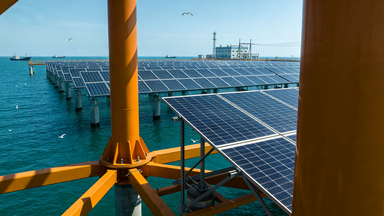
In May 2025, China successfully connected its first pile-foundation fixed offshore solar power project to the grid—the 400 MW Yantai Zhaoyuan offshore solar farm located in Laizhou Bay, Shandong Province. This pioneering project, situated 2 to 6.2 kilometers off the coastline in water depths of 8.5 to 11 meters, utilizes domestically developed offshore-specific solar modules that can withstand harsh marine conditions such as high salt spray, humidity, and strong winds. It is expected to generate an average of 694 million kilowatt-hours (kWh) of electricity annually, equivalent to reducing standard coal consumption by approximately 208,700 metric tons and cutting carbon dioxide emissions by about 535,800 tons per year. This project marks a significant advancement in China's pursuit of large-scale renewable energy development in marine environments, complementing its existing offshore wind power capabilities.
2. Distributed PV: Empowering Local Energy Self-Sufficiency
Distributed photovoltaic systems, which generate electricity close to the point of consumption, have become a key pillar of China solar energy strategy. To address challenges such as voltage overruns and transformer overloads in low-voltage PV systems, China Electric Power Research Institute developed a cutting-edge intelligent perception and regulation technology. This technology, which includes high-speed carrier-wireless dual-mode communication and multi-level topology identification with 100% accuracy, has been deployed nationwide, enabling intelligent monitoring of over 7.8 million low-voltage distributed PV systems with an adjustable capacity exceeding 280 GW. The technology has also been exported to countries like Kyrgyzstan and Indonesia, generating over 6.53 billion yuan in economic benefits over three years and providing a Chinese solution for global distributed PV grid integration.

Technological Innovation: Driving Efficiency and Cost Competitiveness
A key driver of China's solar success is its relentless focus on technological innovation, which has continuously improved panel efficiency and reduced production costs. Chinese manufacturers have been at the forefront of developing advanced solar cell technologies, such as TOPCon (Tunnel Oxide Passivated Contact) and BC (Back Contact) cells, which offer higher conversion efficiency than traditional technologies.
Policy support has played a crucial role in fostering innovation. As early as 2013, the State Council issued guidelines emphasizing the importance of technological progress in the photovoltaic industry, setting efficiency targets for new solar cell projects and supporting R&D into high-purity materials and advanced manufacturing equipment. More recently, mandatory national standards on energy consumption limits for polysilicon and energy efficiency grades for PV modules have been proposed to drive the elimination of backward产能 and promote high-quality development.
These efforts have paid off: Chinese solar panels now boast some of the highest conversion efficiencies in the world, while production costs have plummeted over the past decade, making solar energy increasingly competitive with fossil fuels without subsidies.
Policy Framework and Market Transition: Towards High-Quality Development
China's solar energy boom has been guided by a comprehensive policy framework that balances scale expansion with structural optimization. Early policies focused on expanding domestic applications through distributed PV and large-scale solar farms, with targets to reach 35 GW of total installed capacity by 2015—a goal that was far exceeded.
In recent years, the policy focus has shifted towards high-quality development and market-oriented reform. The 2025 "Notice on Deepening the Market-Oriented Reform of New Energy Grid-Connected Tariffs" requires that new energy power, including solar, be integrated into the electricity market, with prices determined through market transactions. This reform aims to improve the sustainability of the solar industry by reducing reliance on government subsidies and fostering a more market-driven ecosystem.
To address issues of overcapacity and homogeneous competition, the industry is undergoing a "de内卷" (anti-involution) transformation, with efforts to promote mergers and acquisitions, eliminate backward产能, and encourage differentiated competition through technological innovation. A newly established polysilicon capacity integration platform, initiated by leading enterprises and guided by government departments, is expected to play a key role in regulating the market and improving industry profitability, with the industry poised for a profit inflection point in 2026.
Future Outlook: China Solar Energy in the Global Energy Transition
Looking ahead, China solar energy is set to play an even more important role in the country's dual carbon goals (peak carbon emissions by 2030 and carbon neutrality by 2060) and the global renewable energy revolution. Domestic demand is expected to be supported by the greening of industrial and residential electricity consumption, the growth of electrification in transportation and heating, and the development of new applications such as green hydrogen production using solar power.
Internationally, China will continue to be a major supplier of solar products and technologies, supporting global solar deployment. Chinese enterprises are also expanding their global footprint through overseas manufacturing facilities to avoid trade barriers and tap into growing markets in Southeast Asia, the Middle East, and other regions.

Conclusion: China's Solar Leadership Shapes the Future of Energy
China solar energy has come a long way from its early days, evolving into a global leader in scale, technology, and innovation. Through a combination of strategic policy guidance, technological breakthroughs, and large-scale deployment, China has not only transformed its own energy structure but also made a significant contribution to global efforts to combat climate change.
As the industry enters a new phase of high-quality development, China's focus on efficiency, sustainability, and market-driven growth will ensure that its solar sector remains a key driver of the global energy transition. For businesses, investors, and policymakers around the world, understanding China's solar journey offers valuable insights into the potential of renewable energy to reshape our energy future.
pros of solar energy
pros and cons of solar energy
Related Article
In an era where climate change urgency and energy security concerns dominate global conversations, the shift to renewable energy has moved from a "nice-to-have" to a necessity.
green mountain energy

As the global community grapples with climate change, energy security, and rising fossil fuel costs, solar energy has emerged as a beacon of hope in the transition to a cleaner, more sustainable energy system.
pros of solar energy

