home solar energy
2025-12-10
Home Solar Energy: Your Guide to Clean, Cost-Saving Power for Your House
Picture this: You wake up, make coffee, charge your phone, and run the dishwasher—all while your roof is quietly generating free electricity from the sun. No more sticker shock from monthly utility bills, no guilt about carbon emissions, and even a buffer against power outages. This isn’t a futuristic dream—it’s the reality of home solar energy, a technology that’s transforming how homeowners power their lives. But what exactly is home solar energy, how does it work, and is it right for you? Let’s dive into everything you need to know.

First: What Is Home Solar Energy?
At its simplest, home solar energy is the process of capturing sunlight and converting it into usable electricity to power your household. Unlike traditional grid power (which relies on fossil fuels like coal or natural gas), home solar is a renewable, clean energy source—meaning it never runs out and doesn’t release harmful greenhouse gases.
The core system for most homes is a residential solar photovoltaic (PV) system, which consists of four key components:
- Solar Panels: The most visible part—usually mounted on your roof (or ground) to absorb sunlight.
- Inverter: Converts the direct current (DC) electricity generated by panels into alternating current (AC), which powers your home’s appliances and lights.
- Mounting Racks: Secure the panels to your roof (or ground) at the optimal angle to capture sunlight.
- Net Meter: A special meter installed by your utility company that tracks how much electricity your system generates vs. how much you use. If you generate more than you need, the excess flows back to the grid (and you get credited for it—more on that later!).
Optional add-ons:
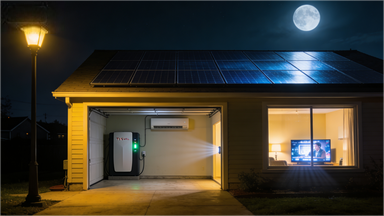
- Solar Battery Storage: Stores excess energy for use at night, during cloudy days, or power outages (e.g., Tesla Powerwall, LG Chem RESU).
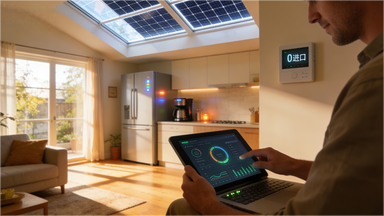
- Smart Energy Management System: Lets you monitor and optimize your energy use via a phone app (e.g., track panel output, control appliances remotely).
How Does Home Solar Energy Work? (It’s Simpler Than You Think!)
You don’t need an engineering degree to understand the basics—here’s a step-by-step breakdown of how sunlight becomes electricity for your home:
Step 1: Solar Panels Capture Sunlight
Each solar panel is made of 60–72 solar cells (usually silicon-based, the same material in computer chips). When sunlight hits these cells, it knocks electrons loose from their atoms—creating a flow of electricity (this is called the "photovoltaic effect").
Fun fact: Solar panels work even on cloudy days! They don’t need direct sunlight—diffused light (from clouds) still generates electricity, just at a lower rate (about 10–25% of peak output).
Step 2: Inverter Converts the Electricity
The electricity generated by panels is DC (direct current), but your home uses AC (alternating current)—the same type as grid power. The inverter’s job is to convert DC to AC so you can power your fridge, TV, and lights.
There are two main inverter types:
- String Inverters: A single inverter for all panels (cheaper, simpler).
- Microinverters: One inverter per panel (more efficient, especially if some panels are shaded).
Step 3: Power Your Home (and Save Money!)
Once converted to AC, the electricity flows directly to your home’s electrical panel (breaker box) and powers your devices in real time. Here’s where the magic happens:
- If your system generates more electricity than you use (e.g., during midday when no one’s home), the excess flows back to the utility grid.
- Your net meter tracks this "exported" energy, and your utility company credits you for it (this is called net metering—it’s like getting paid to power your neighborhood!).
- At night or on cloudy days, when your panels aren’t generating enough, you draw electricity from the grid as usual—but your credits offset the cost.
Step 4: (Optional) Store Excess Energy with a Battery
If you want to be less reliant on the grid (or prepare for power outages), a solar battery stores the excess energy your panels generate during the day. You can use this stored power at night, during storms, or when electricity rates are highest—giving you complete energy independence.

The Top 5 Benefits of Home Solar Energy
Why are millions of homeowners switching to solar? Here are the most compelling reasons:
1. Slash Your Monthly Electricity Bills
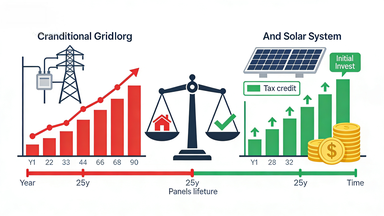
This is the biggest draw. Depending on where you live and the size of your system, home solar can reduce your electricity bills by 50–100%. For example:
- A typical U.S. household pays ~\(150/month for electricity (\)1,800/year).
- A 6kW solar system (enough for most homes) can save \(1,000–\)1,500/year.
- Over 25 years (the lifespan of solar panels), that’s \(25,000–\)37,500 in savings—far more than the cost of installation.
2. Reduce Your Carbon Footprint
Home solar is one of the easiest ways to go green. A single 6kW solar system offsets ~7,000 pounds of carbon dioxide per year—equivalent to planting 100 trees or driving 8,000 miles less. By 2030, residential solar could reduce global emissions by 1.8 billion tons—helping fight climate change one home at a time.
3. Increase Your Home’s Value
Solar panels are a smart investment. Studies show homes with solar sell 20% faster and for 4–5% more money than comparable non-solar homes. For a \(500,000 home, that’s an extra \)20,000–$25,000 in resale value—with no extra work on your part.
4. Energy Independence (and Protection from Rate Hikes)
Utility rates rise an average of 3–5% per year. With solar, you lock in your electricity costs for 25+ years—no more worrying about price spikes. Plus, if you add a battery, you’re not at the mercy of power outages (critical during storms or grid failures).
5. Tax Credits and Incentives
Governments and utilities offer generous perks to encourage solar adoption:
- U.S. Federal Solar Tax Credit: Covers 30% of the cost of installation (e.g., a \(20,000 system costs \)14,000 after the credit).
- State/Local Incentives: Rebates, tax breaks, or low-interest loans (e.g., California’s Solar Initiative, New York’s NY-Sun program).
- Net Metering: As mentioned earlier, utilities credit you for excess energy—some states even offer "feed-in tariffs" (higher rates for exported power).
-
What You Need to Know Before Installing Home Solar
Solar isn’t a one-size-fits-all solution—here are key factors to consider:
1. Is Your Roof Suitable?
Your roof needs three things:
- Sun Exposure: At least 4–6 hours of direct sunlight per day (avoid heavy shading from trees, chimneys, or neighboring buildings).
- Roof Condition: A roof that’s less than 10 years old (if it’s older, you’ll need to replace it before installing panels—saves money in the long run).
- Roof Space: A typical 6kW system needs ~400 square feet of space (15–20 panels, each ~20 square feet).
If your roof isn’t suitable (e.g., too small, shaded), you can install a ground-mounted system (in your yard) or use community solar (subscribe to a shared solar farm and get credits on your bill).
2. How Much Does It Cost? (And How to Pay for It)
- Average Cost: A residential solar system costs \(2.50–\)3.50 per watt (before incentives). A 6kW system is ~\(15,000–\)21,000—after the 30% federal tax credit, that drops to \(10,500–\)14,700.
- Financing Options:
-
- Cash Purchase: Save the most money (no interest).
-
- Solar Loan: Low-interest loans (3–5% APR) with monthly payments often lower than your current electricity bill.
-
- Lease/Power Purchase Agreement (PPA): No upfront cost—pay a fixed monthly fee for the energy your system generates (good for homeowners who don’t want to invest upfront).
3. Maintenance Requirements
Solar panels are low-maintenance—here’s what you need to do:
- Cleaning: Rinse panels with water 2–4 times a year (or hire a professional for \(100–\)200). Dirt, leaves, or snow can reduce efficiency.
- Inspections: Have a professional inspect the system every 5–10 years (most installers offer warranties that cover repairs).
- Warranties: Panels come with 25–30 year performance warranties (they’ll generate at least 80% of their original output after 25 years). Inverters have 10–15 year warranties.
4. Net Metering Policies Vary by Location
Net metering is a game-changer, but rules differ by state/country. Some utilities limit how much you can export, or reduce credits after a certain amount. Always check your local utility’s net metering policy before installing.

Real-Life Example: A Homeowner’s Solar Journey
Meet Sarah, a homeowner in Denver, Colorado:
- She installed a 7kW solar system (22 panels) on her roof in 2020, costing $18,000 before incentives.
- After the 30% federal tax credit and a \(2,000 state rebate, her total cost was \)10,600.
- Her monthly electricity bill dropped from \(170 to \)25 (she only pays the utility’s "base fee" for grid access).
- In 3 years, she’s saved $5,220—on track to recoup her investment in ~2 years.
- During a winter blizzard that knocked out power for 2 days, her solar battery kept her fridge, lights, and heater running.
"Solar was the best financial decision I’ve ever made," Sarah says. "I not only save money but also feel good about doing my part for the planet."
The Future of Home Solar Energy
Home solar is only getting better—here’s what’s coming next:
- More Efficient Panels: Today’s panels have a conversion efficiency of 15–22%. New technologies (like perovskite solar cells) could push that to 30%+ in the next 5–10 years—meaning smaller systems generate more power.
- Cheaper Batteries: Lithium-ion battery costs have dropped 87% since 2010. As prices keep falling, more homeowners will add storage—making solar a 24/7 energy solution.
- Smart Solar Systems: AI-powered tools will optimize energy use (e.g., charging your EV when panels generate the most power, shifting usage to off-peak hours).
- Solar Shingles/Tiles: Sleeker alternatives to traditional panels (e.g., Tesla Solar Roof) that blend in with your roof—perfect for homeowners who want a clean look.
Is Home Solar Right for You?
If you:
- Pay high electricity bills (>$100/month).
- Have a roof with good sun exposure.
- Plan to live in your home for 5+ years.
- Want to reduce your carbon footprint.
Then yes—home solar is likely a smart investment. Even if you don’t plan to stay forever, the increased home value and monthly savings make it worth it.
To get started:
- Get a free quote from 2–3 local solar installers (they’ll assess your roof and provide a custom plan).
- Compare costs, warranties, and financing options.
- Apply for incentives (your installer can help with this).
- Sit back and watch your savings grow!
-
Final Thoughts: Home Solar Is More Than Power—It’s Freedom
Home solar energy isn’t just about generating electricity—it’s about taking control of your energy costs, reducing your environmental impact, and building a more resilient home. As technology improves and costs drop, solar is becoming accessible to more homeowners than ever before.
Do you have questions? Want to know how much solar would cost for your home, or how to find a reputable installer? Drop a comment below—I’m here to help you navigate your solar journey!
all energy solar
solar energy world
Related Article
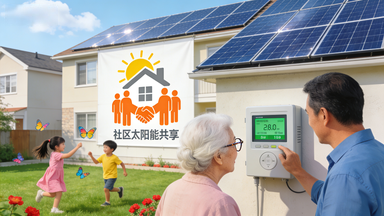
In an era where climate change urgency and energy security concerns dominate global conversations, the shift to renewable energy has moved from a "nice-to-have" to a necessity.
green mountain energy

As the global community grapples with climate change, energy security, and rising fossil fuel costs, solar energy has emerged as a beacon of hope in the transition to a cleaner, more sustainable energy system.
pros of solar energy