charge car battery with solar
2025-12-23

Charging Your Car Battery with Solar: A Sustainable and Cost-Effective Solution
As the world shifts toward greener energy alternatives and the popularity of electric vehicles (EVs) continues to soar, more and more car owners are exploring ways to reduce their carbon footprint while cutting down on energy costs. One innovative and increasingly accessible solution is charging your car battery with solar power. This approach not only leverages a clean, renewable energy source but also offers long-term financial benefits and greater energy independence. Whether you’re an EV enthusiast, a eco-conscious driver, or simply curious about sustainable transportation, this blog will break down everything you need to know about charging your car battery with solar—from how it works to its key advantages and practical considerations.

Is Charging a Car Battery with Solar Feasible?
The short answer is yes—charging a car battery with solar power is not only feasible but also a mature technology that’s becoming more mainstream. Solar-powered car charging works by converting sunlight into electricity using photovoltaic (PV) panels, which is then stored in a battery system or directly used to charge your car’s battery. This process is compatible with both fully electric vehicles and plug-in hybrid electric vehicles (PHEVs), as well as traditional gasoline-powered cars (though it’s most commonly used for EVs due to their higher energy demands).
Advancements in solar panel efficiency, battery storage technology, and EV charging systems have made this solution more practical than ever. Modern solar panels can convert a higher percentage of sunlight into usable electricity, even in less-than-ideal weather conditions, while dedicated solar EV chargers (often called “solar car chargers” or “PV car chargers”) are designed to seamlessly integrate with both residential and commercial solar setups.
Key Advantages of Charging Your Car Battery with Solar
Charging your car battery with solar offers a range of benefits that make it an attractive option for many drivers. Here are the most notable advantages:
1. Zero Carbon Emissions, Maximum Environmental Impact
The biggest draw of solar-powered car charging is its environmental friendliness. Unlike grid electricity, which often comes from fossil fuels like coal or natural gas, solar energy is 100% renewable and produces no greenhouse gas emissions during generation. By charging your car with solar, you’re directly reducing your carbon footprint and contributing to the fight against climate change. For example, an average EV driven 10,000 miles per year emits approximately 0 tons of tailpipe emissions, and if charged with solar, its entire lifecycle emissions are drastically lower compared to gasoline-powered cars or EVs charged with grid electricity.
2. Significant Long-Term Cost Savings
While the initial investment in solar panels and a solar car charger may seem substantial, the long-term cost savings are impressive. Once your solar system is installed, the sunlight you use to charge your car is free—meaning you’ll no longer have to pay for electricity from the grid to power your EV. Over time, these savings can add up to thousands of dollars. For instance, if the average cost of grid electricity is $0.15 per kWh and your EV uses 30 kWh to travel 100 miles, charging 10,000 miles per year would cost $450 with grid power. With solar, that cost drops to nearly zero after the initial setup is paid off. Additionally, many regions offer tax incentives, rebates, or net metering programs that can offset the upfront costs and accelerate your return on investment.
3. Energy Independence and Grid Resilience
Charging your car with solar gives you greater control over your energy supply. You won’t be affected by fluctuations in grid electricity prices or power outages, as you’ll have your own renewable energy source. This is particularly beneficial for drivers who live in areas with unreliable power grids or those who want to reduce their dependence on traditional energy providers. If you pair your solar system with a battery storage unit, you can store excess solar energy generated during the day to charge your car at night or during cloudy weather, further enhancing your energy independence.
4. Low Maintenance and Long Lifespan
Solar panels and solar car chargers require minimal maintenance. Solar panels typically have a lifespan of 25-30 years, with most manufacturers offering warranties of 20+ years. Routine maintenance usually involves cleaning the panels a few times a year to remove dirt, dust, or debris. Solar car chargers are also designed to be durable and low-maintenance, with many featuring weather-resistant designs that can withstand harsh outdoor conditions. This means you’ll enjoy reliable solar charging for years with minimal upkeep.

How to Charge Your Car Battery with Solar: 2 Main Approaches
There are two primary ways to charge your car battery with solar: using a residential solar system with a dedicated EV charger, or using a portable solar charger. Each approach has its own advantages and is suited to different needs.
1. Residential Solar System with a Solar EV Charger (Permanent Setup)
This is the most common and efficient approach for long-term solar car charging. It involves installing solar panels on your roof (or a ground-mounted system on your property) and connecting them to a solar inverter and a dedicated EV charger (often called a “Level 2 charger”). Here’s how it works:
-
Solar panels capture sunlight and convert it into direct current (DC) electricity.
-
The solar inverter converts the DC electricity into alternating current (AC) electricity, which is used to power your home and charge your car.
-
The dedicated solar EV charger is hardwired to your electrical system and provides a faster charging rate than a standard Level 1 charger (which plugs into a regular household outlet). Most Level 2 solar EV chargers can fully charge an EV battery in 4-8 hours, depending on the battery capacity.
Many modern solar EV chargers also come with smart features, such as the ability to monitor your solar energy production and charging usage via a mobile app, or to prioritize charging with solar energy first (before drawing power from the grid). This ensures you’re maximizing your use of renewable energy and minimizing your reliance on grid power.
2. Portable Solar Charger (Temporary/On-the-Go Setup)
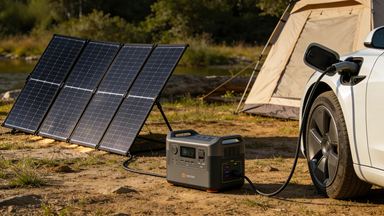
For drivers who need flexibility or don’t have access to a permanent residential solar system, a portable solar charger is a great option. These are lightweight, foldable solar panels that can be easily transported and set up anywhere there’s sunlight. Here’s how it works:
-
The portable solar panel is unfolded and placed in a sunny area (e.g., your car’s roof, the ground, or a campsite).
-
The panel is connected to a charge controller (which regulates the voltage to prevent overcharging) and then to your car’s battery or a portable power station (which stores the solar energy and can later be used to charge your car).
-
Portable solar chargers are typically Level 1 chargers, meaning they charge more slowly than Level 2 chargers (often taking 12-24 hours to fully charge an EV battery). However, they’re ideal for emergency charging, road trips, camping, or other situations where grid power is unavailable.
-
Key Considerations Before Switching to Solar Car Charging
Before investing in a solar car charging system, there are a few important factors to consider to ensure it’s the right fit for you:
1. Solar Irradiance in Your Area
Solar irradiance refers to the amount of sunlight your area receives. Regions with high solar irradiance (e.g., sunny states like California, Arizona, or Florida) will generate more solar energy, making solar car charging more efficient. However, even areas with moderate sunlight (e.g., the Pacific Northwest or the Northeast) can still benefit from solar charging, thanks to advancements in panel efficiency. You can check the solar irradiance in your area using online tools like the National Renewable Energy Laboratory’s (NREL) PVWatts Calculator.
2. Available Space for Solar Panels
For a residential solar system, you’ll need enough space on your roof or property to install the necessary number of solar panels. The number of panels you need depends on your car’s energy consumption and your household’s electricity needs. On average, a typical EV requires 6-12 solar panels to cover its annual charging needs (assuming each panel is 300-400 watts). If you don’t have enough roof space, a ground-mounted system or a solar carport (which combines a carport with solar panels) is a great alternative.
3. Compatibility with Your Car and Charging System
Before purchasing a solar EV charger, ensure it’s compatible with your car. Most modern EVs and PHEVs are compatible with Level 2 chargers, but it’s always best to check your car’s owner’s manual or contact the manufacturer to confirm. Additionally, if you’re using a portable solar charger, make sure it’s compatible with your car’s battery voltage and connector type (e.g., Type 1, Type 2, CCS, or CHAdeMO).
4. Upfront Costs and Return on Investment
The upfront cost of a residential solar system with a solar EV charger can range from $10,000 to $30,000, depending on the size of the system, the type of panels and charger, and installation costs. However, as mentioned earlier, tax incentives, rebates, and net metering can significantly reduce this cost. The return on investment (ROI) typically ranges from 5-10 years, depending on your energy usage and local electricity prices. For drivers who use their EV daily, the ROI will be faster.

Tips for Maximizing Solar Car Charging Efficiency
To get the most out of your solar car charging system, follow these tips:
-
Charge during peak sunlight hours: The sun is strongest between 10 a.m. and 4 p.m., so try to charge your car during these hours to maximize your use of solar energy.
-
Keep solar panels clean: Dirty or dusty panels can reduce efficiency by up to 25%. Clean your panels regularly with a soft brush or hose to remove debris.
-
Use a smart charger: Smart solar EV chargers can automatically adjust charging times to align with peak solar production, ensuring you’re using the most renewable energy possible.
-
Pair with battery storage: Adding a battery storage unit to your solar system allows you to store excess solar energy for charging at night or during cloudy weather, further reducing your reliance on the grid.
Conclusion: Is Solar Car Battery Charging Right for You?
Charging your car battery with solar is a smart, sustainable, and cost-effective solution for drivers who want to reduce their carbon footprint and save money on energy costs. Whether you opt for a permanent residential solar system with a Level 2 charger or a portable setup for on-the-go charging, solar power offers greater energy independence and long-term value. While the upfront investment may be a barrier for some, the environmental benefits and long-term savings make it a worthwhile investment for many.
As solar technology continues to advance and become more affordable, charging your car with solar will only become more accessible. If you’re ready to take the leap toward greener transportation, solar car battery charging is a great way to make a positive impact on the planet while enjoying the convenience and savings of renewable energy.
home solar and battery
lithium battery solar charge controller
Related Article

In an era where climate change urgency and energy security concerns dominate global conversations, the shift to renewable energy has moved from a "nice-to-have" to a necessity.
green mountain energy

As the global community grapples with climate change, energy security, and rising fossil fuel costs, solar energy has emerged as a beacon of hope in the transition to a cleaner, more sustainable energy system.
pros of solar energy