lifepo4 battery life
2025-12-18
Battery life is typically measured in charge-discharge cycles—the number of times a battery can be fully charged and discharged before its capacity drops to 80% of its original rating (this is called the “end-of-life” threshold).
For LiFePO4 batteries, the lifespan is impressive:
- Typical cycle life: 2,000–10,000 cycles (depending on usage and quality).
- High-end LiFePO4 batteries (e.g., from reputable brands like Battle Born, Victron Energy) can reach 5,000–10,000 cycles with proper care.
- By contrast, lead-acid batteries (flooded, AGM, gel) only last 300–1,000 cycles—a fraction of LiFePO4’s lifespan.
To put this in perspective: If you use your battery once per week (1 cycle/week), a 5,000-cycle LiFePO4 battery could last ~96 years—while a lead-acid battery would die in 5–19 years. Even with daily use (365 cycles/year), a 2,000-cycle LiFePO4 battery lasts ~5.5 years, vs. 1–3 years for lead-acid.


Why LiFePO4 Batteries Last So Much Longer
LiFePO4 chemistry is inherently more stable than other lithium-ion or lead-acid alternatives:
- No memory effect: Unlike nickel-cadmium (NiCd) batteries, LiFePO4 batteries don’t “remember” partial discharges—you can charge them anytime without reducing capacity.
- Robust cathode structure: The iron phosphate cathode resists degradation from repeated charging/discharging. Lead-acid batteries, by contrast, suffer from sulfation (lead sulfate buildup) that permanently reduces capacity over time.
- Wider operating window: LiFePO4 batteries perform reliably across a broader temperature range (-20°C to 60°C / -4°F to 140°F) and tolerate deeper discharges without damage.
Key Factors That Shorten LiFePO4 Battery Life
While LiFePO4 is durable, poor usage habits can still accelerate degradation. Here are the biggest culprits:
1. Depth of Discharge (DOD)
DOD refers to how much of the battery’s capacity you use before recharging. LiFePO4 batteries handle deep discharges better than lead-acid, but deeper discharges still reduce cycle life:
- 100% DOD (using all capacity): ~2,000–3,000 cycles.
- 80% DOD (leaving 20% charge): ~3,000–5,000 cycles.
- 50% DOD (leaving 50% charge): ~5,000–8,000 cycles.
- 20% DOD (leaving 80% charge): 10,000+ cycles.
Example: A solar system battery discharged to 50% daily will last 2–3x longer than one discharged to 100% daily.
2. Temperature Extremes
Heat is the #1 enemy of all batteries—LiFePO4 included:
- Charging at high temps (>45°C / 113°F): Accelerates internal degradation and can cut cycle life by 50% or more.
- Discharging at extreme temps (°C / 14°F): Reduces capacity temporarily and, over time, damages the battery.
- Storage in hot/cold environments: Storing a fully charged or fully discharged battery in extreme temperatures (e.g., a hot RV garage in summer) causes permanent damage.
3. Overcharging/Undercharging
LiFePO4 batteries have strict voltage limits:
- Recommended charging voltage: 3.4–3.6V per cell (13.6–14.4V for a 12V battery).
- Overcharging (exceeding 3.65V per cell): Causes thermal runaway, permanent capacity loss, and safety risks.
- Undercharging (letting voltage drop below 2.5V per cell): Triggers “deep discharge” damage that’s irreversible.
Never use a lead-acid charger for LiFePO4—invest in a LiFePO4-specific charger with CC/CV (constant current/constant voltage) technology.
4. Poor Quality Batteries
Not all LiFePO4 batteries are created equal. Cheap, low-quality batteries (e.g., no BMS, inferior cells) may claim 5,000 cycles but only last 1,000–2,000. Always choose batteries with a built-in Battery Management System (BMS)—it protects against overcharging, undercharging, overheating, and short circuits.
How to Maximize Your LiFePO4 Battery Life
Follow these tips to get the most out of your LiFePO4 battery:
1. Limit DOD (Avoid Full Discharges)
Aim to keep your battery’s DOD between 20–80% (i.e., don’t let it drop below 20% charge or exceed 80% charge for long periods). For solar systems or RVs, use a battery monitor (e.g., Victron BMV-712) to track DOD and recharge promptly.

2. Charge Smartly
- Use a LiFePO4-specific charger (e.g., NOCO Genius, Victron Blue Smart).
- Charge at a moderate current (0.2C–0.5C, where “C” is the battery’s capacity). For a 100Ah battery, this means 20–50A charging current.
- Avoid charging in extreme heat (wait for the battery to cool to °C / 95°F).
3. Store Properly
- If storing for more than 1 month: Charge the battery to 50–60% capacity.
- Store in a cool, dry place (15°C–25°C / 59°F–77°F).
- Disconnect the battery from devices to prevent parasitic drain.
4. Avoid Extreme Temperatures
- In hot climates: Install the battery in a ventilated area (e.g., a shaded compartment) or use a cooling fan.
- In cold climates: Keep the battery insulated (e.g., with a battery blanket) to prevent deep discharge damage.
5. Maintain the BMS
Ensure the battery’s BMS is functioning properly—most modern LiFePO4 batteries have a BMS that alerts you to issues (e.g., overheating, overcharging). Never bypass the BMS.
Real-World LiFePO4 Battery Life Examples
Let’s look at how LiFePO4 performs in common use cases:
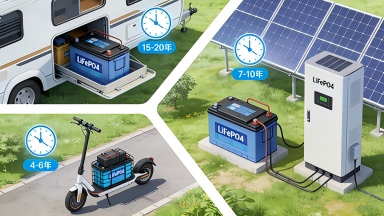
- RV/Boat: A 12V 100Ah LiFePO4 battery used 3x/week (30% DOD per use) will last ~15–20 years. A lead-acid battery in the same scenario lasts 3–5 years.
- Solar Off-Grid System: A 48V 200Ah LiFePO4 bank discharged to 50% daily will last 7–10 years, vs. 2–3 years for lead-acid.
- Electric Scooter/E-Bike: A 36V 15Ah LiFePO4 battery used daily (80% DOD) lasts 4–6 years, vs. 1–2 years for a lithium-ion (Li-ion) battery.
Is LiFePO4 Worth the Investment for Longevity?
Yes—even though LiFePO4 batteries cost 2–3x more upfront than lead-acid, their 3–10x longer lifespan means lower total cost of ownership (TCO). For example:
- Lead-acid: \(300 for 500 cycles = \)0.60 per cycle.
- LiFePO4: \(800 for 5,000 cycles = \)0.16 per cycle.
Over time, LiFePO4 saves you money, reduces waste (fewer battery replacements), and offers more reliable performance.

Final Thoughts
LiFePO4 battery life is unmatched in the rechargeable battery world—offering thousands of cycles, resistance to degradation, and flexibility in usage. By following simple best practices (limiting DOD, avoiding extreme temps, using the right charger), you can extend your LiFePO4 battery’s lifespan even further.
Whether you’re powering a solar system, RV, or electric vehicle, LiFePO4’s long life makes it a smart, sustainable choice that pays off in the long run.
24v lithium battery
48v lifepo4 battery
Related Article

In an era where climate change urgency and energy security concerns dominate global conversations, the shift to renewable energy has moved from a "nice-to-have" to a necessity.
green mountain energy

As the global community grapples with climate change, energy security, and rising fossil fuel costs, solar energy has emerged as a beacon of hope in the transition to a cleaner, more sustainable energy system.
pros of solar energy