solar energy cost
2025-12-09

Solar Energy Cost: What You Need to Know in 2024 (Is It Worth the Investment?)
If you’ve ever stared at your rising electricity bill and thought, “Is solar power finally affordable?” you’re not alone. Solar energy cost has plummeted over the past decade, turning what was once a luxury into a practical choice for millions of homeowners and businesses. But how much does solar energy actually cost today? What hidden expenses should you watch for? And when will you recoup your investment? Let’s demystify solar energy cost—from upfront prices to long-term savings.

First: The Big Picture: How Much Does Solar Energy Cost Now?
Let’s start with hard numbers (US-focused, but trends apply globally):
- Residential Solar Systems: The average cost is \(2.80–\)3.50 per watt in 2024. For a typical 6-kilowatt (kW) system (enough to power a 2,000-square-foot home), that’s a total upfront cost of \(16,800–\)21,000 before incentives.
- After Incentives: With the federal Solar Investment Tax Credit (ITC)—which covers 30% of your system cost—your out-of-pocket expense drops to \(11,760–\)14,700. Many states and utilities add rebates or tax credits, slashing costs even more (e.g., California offers up to $1,000 in rebates, while New York’s NY-Sun program covers an extra 10–20%).
- Commercial/Utility-Scale Solar: For businesses or power plants, costs are even lower—\(1.00–\)1.50 per watt. A 1-megawatt (MW) commercial system costs ~\(1–\)1.5 million, with faster payback periods due to larger energy usage.
To put this in context: In 2010, solar energy cost was $35 per watt for residential systems. That means today’s prices are 90% cheaper than they were 14 years ago. This isn’t a small drop—it’s a revolution that’s made solar accessible to middle-class households.
Breaking Down Solar Energy Cost: What You’re Actually Paying For
When you buy a solar system, your total cost isn’t just for the panels. Here’s the breakdown of where your money goes (residential systems):
|
Cost Component
|
Percentage of Total Cost
|
What It Covers
|
|
Solar Panels
|
30–40%
|
The photovoltaic (PV) panels that convert sunlight to electricity. Premium panels (e.g., monocrystalline) cost more but are more efficient.
|
|
Installation & Labor
|
20–30%
|
Hiring certified installers to mount panels, wire the system, and connect it to your home’s electrical grid. Complex roofs (e.g., steep or tile) or hard-to-reach areas raise labor costs.
|
|
Inverter
|
10–15%
|
The device that converts DC electricity (from panels) to AC electricity (for your home). String inverters are cheaper (~\(1,000–\)2,000), while microinverters (per-panel) cost more (~\(3,000–\)5,000) but boost efficiency.
|
|
Mounting Hardware
|
5–10%
|
Racks, brackets, and screws to secure panels to your roof (or ground, for ground-mounted systems).
|
|
Permits & Inspections
|
5–10%
|
Local government permits, utility interconnection fees, and inspections to ensure compliance with safety codes.
|
|
Additional Equipment
|
5–10%
|
Batteries (if you want energy storage), monitoring systems (to track production), or upgrades to your electrical panel (if it’s outdated).
|
The Biggest Cost Variable: Batteries
Adding a solar battery (e.g., Tesla Powerwall, LG Chem) can add \(10,000–\)15,000 to your total cost (for a 13–16 kWh battery). Batteries let you store excess solar energy for nights or power outages, but they’re optional—many homeowners skip them and rely on the grid for backup (using “net metering” to sell excess energy back to the utility).

How Much Has Solar Energy Cost Dropped Over Time?
The steep decline in solar energy cost is one of the most remarkable stories in renewable energy. Here’s the data from the U.S. Department of Energy (DOE):
- 2010: $35 per watt (residential solar)
- 2015: $3.50 per watt
- 2020: $2.90 per watt
- 2024: \(2.80–\)3.50 per watt (stable, with minor fluctuations due to supply chain costs)
Why the drop? Three key factors:
- Mass Production: Global manufacturing of solar panels (led by China) has scaled up, driving down material costs (silicon, aluminum).
- Technological Advances: Panels are more efficient (converting 20–23% of sunlight to electricity today, vs. 15% in 2010), so you need fewer panels to power your home.
- Policy Support: Federal, state, and local incentives (like the ITC) have spurred demand, leading to economies of scale for installers.
What Impacts Your Solar Energy Cost?
No two solar installations cost the same. Here are the top factors that will affect your bill:
1. Your Home’s Energy Needs
The bigger your energy usage (e.g., electric cars, central AC, large families), the larger the system you need. A home using 1,000 kWh/month needs a 7–8 kW system (~\(20,000–\)28,000 upfront), while a home using 500 kWh/month needs a 3–4 kW system (~\(8,400–\)14,000 upfront).

2. Location, Location, Location
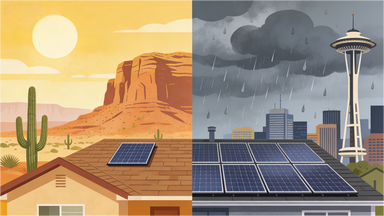
- Sunlight: Homes in sunny states (Arizona, California, Florida) need fewer panels (lower cost) because they generate more energy per panel. A 6 kW system in Arizona produces ~9,000 kWh/year, while the same system in Seattle produces ~5,000 kWh/year (so Seattle homeowners may need a larger, more expensive system).
- Local Incentives: States like Massachusetts offer $0.20/kWh for solar production (via net metering), while Texas has no state rebates—this can swing your total cost by thousands.
- Utility Rates: Higher electricity rates (e.g., $0.30/kWh in Hawaii) mean faster savings, making solar more cost-effective even with a higher upfront investment.
3. Roof Condition & Type
- Roof Age: If your roof is 15+ years old, you’ll need to replace it before installing solar (~\(5,000–\)10,000 extra cost).
- Roof Material: Asphalt shingle roofs are cheapest to install on (\(1–\)2 per square foot in labor), while tile or slate roofs require special mounting (adding \(2,000–\)5,000).
- Shade: Trees or nearby buildings blocking sunlight mean you’ll need more panels (or expensive shade-tolerant panels) to meet your energy needs.
4. Installation Company
Prices vary by installer—big national companies (e.g., Sunrun, Vivint) often charge 10–20% more than local, family-owned firms. Always get 3–5 quotes to compare (and check reviews for quality—cheap installers may cut corners on materials or labor).
Solar Energy Cost vs. Long-Term Savings: Is It Worth It?
The biggest question: Will the upfront cost of solar be offset by savings? For most homeowners, the answer is yes—eventually. Here’s how to calculate your payback period (time to recoup your investment):
Example: A Typical Home in California
- Upfront cost (6 kW system): $18,000
- Federal ITC (30%): -$5,400
- State rebate: -$1,000
- Net cost: $11,600
- Annual energy savings: \(1,800 (based on \)0.25/kWh utility rate)
- Payback period: ~6.4 years
After that, you’ll get free electricity for 20–25 years (the lifespan of solar panels). For this home, that’s ~\(36,000–\)45,000 in total savings over 25 years.
Even Better: Solar Increases Home Value
A 2023 study by Zillow found that homes with solar panels sell for 4.1% more than comparable homes without them. For a \(500,000 home, that’s an extra \)20,500—often more than the cost of the solar system.

Hidden Costs (and How to Avoid Them)
Solar energy cost isn’t just upfront—watch for these hidden expenses:
- Maintenance: Panels need occasional cleaning (\(100–\)200/year) and inverter replacement (\(1,000–\)3,000 every 10–15 years).
- Utility Fees: Some utilities charge “demand fees” or “grid access fees” for solar users (e.g., $50/month in Nevada)—ask your utility about these before installing.
- Warranties: Cheap systems may have short warranties (5–10 years for panels), while premium systems offer 25-year warranties. Paying a little more upfront for a good warranty avoids costly repairs later.
The Future of Solar Energy Cost: Will It Keep Dropping?
Experts predict solar energy cost will continue to fall—though not as rapidly as in the 2010s. Here’s why:
- New Technologies: Perovskite solar cells (cheaper to make than silicon) could reduce panel costs by 50% in the next decade.
- Battery Cost Drops: Solar battery prices have fallen 89% since 2010 (from \(1,200/kWh to \)137/kWh in 2023) and will keep dropping, making energy storage more affordable.
- Grid Integration: As more solar is added to the grid, utilities may offer better net metering rates or demand-response programs, increasing savings for homeowners.
Final Thoughts: Is Solar Energy Cost Worth It for You?
Solar energy cost is no longer a barrier for most households—especially if you live in a sunny state with high utility rates. The key questions to ask:
- How long do you plan to stay in your home? (You need to live there long enough to recoup the investment—usually 5–10 years.)
- What are your local incentives? (Use the Database of State Incentives for Renewables & Efficiency (DSIRE) to check.)
- What’s your roof’s condition? (Replace it before solar if needed to avoid extra costs.)
-
If you’re on the fence, get a free solar quote from a local installer—they’ll calculate your exact cost, savings, and payback period based on your home’s unique details.
Have you installed solar panels? What was your experience with solar energy cost? Or do you have questions about incentives or system sizes? Drop a comment below—I’d love to hear from you!
solar energy world
what is energy
Related Article

In an era where climate change urgency and energy security concerns dominate global conversations, the shift to renewable energy has moved from a "nice-to-have" to a necessity.
green mountain energy
As the global community grapples with climate change, energy security, and rising fossil fuel costs, solar energy has emerged as a beacon of hope in the transition to a cleaner, more sustainable energy system.
pros of solar energy